The Best Performance Management Software for 2026
June 12, 2026
Walter Write
7 min read

Most performance management software is a forms engine. Goals get typed in January, ratings get typed in December, and the software's job is to route the forms. In 2026 the tools worth paying for do something different: they pull evidence from the systems where work already happens, GitHub, Jira, calendars, CRM, and put it in front of the manager before the review starts.
We first published this guide for 2025. This is the rewritten 2026 edition, and the old page now redirects here. The short version: seven tools are worth your shortlist, and which one you pick depends less on feature checklists than on where you want review evidence to come from.
What actually changed in 2026
Two things, and only one of them is the AI you keep hearing about.
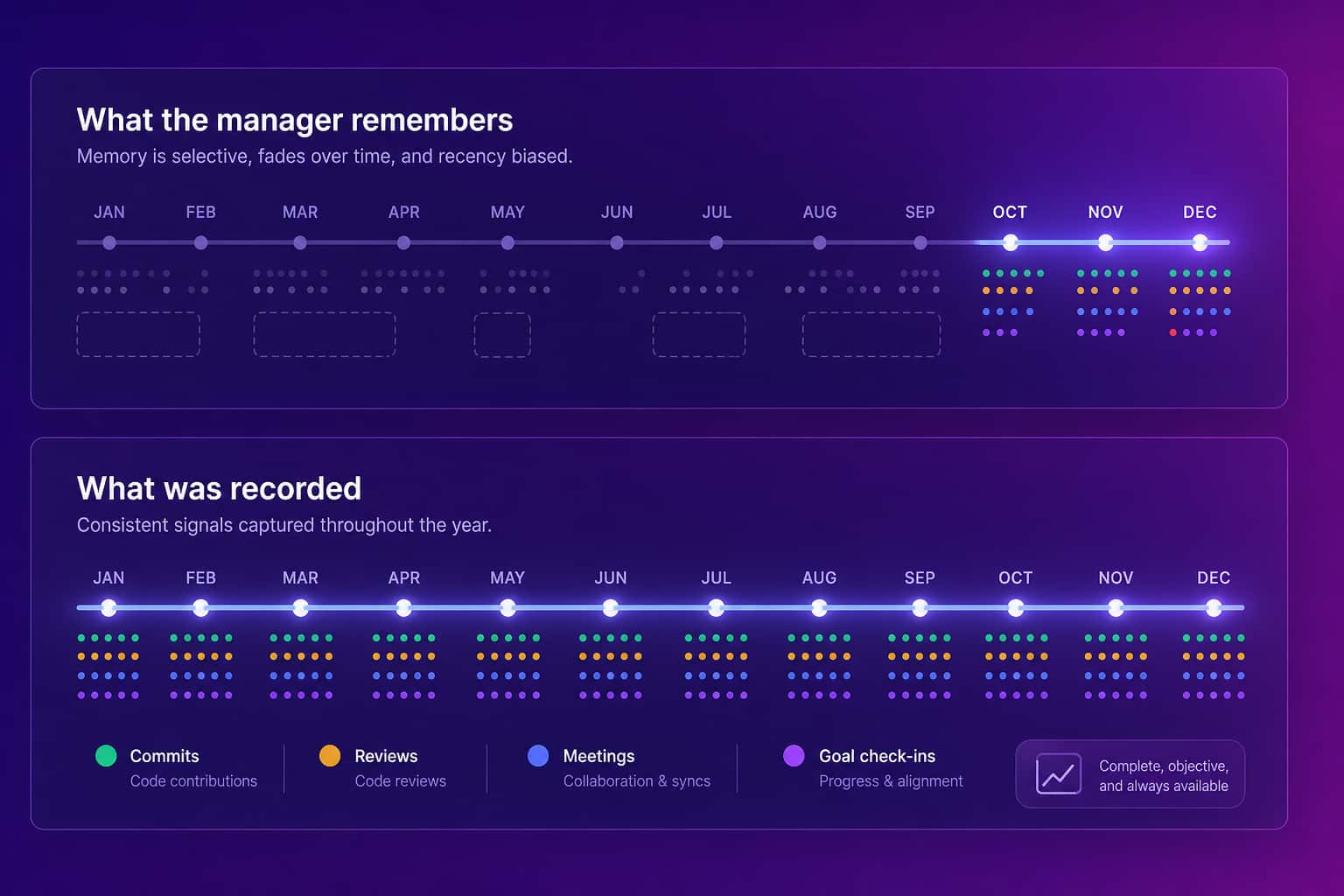
The first shift is where review data comes from. A manager writing a December review is reconstructing March from memory, and memory is bad at this. Recency bias is the documented failure mode: the last six weeks swallow the previous ten months. Tools that record work signals continuously (delivery data, review activity, meeting load, goal progress) give the manager a record instead of a recollection. We made the longer argument in continuous performance management vs annual reviews.
The second shift is what AI does inside these tools. Through 2024 and 2025, "AI" in performance management mostly meant a button that drafts a review summary from text the manager already wrote. That saves typing. It does not fix the evidence problem, because a fluent summary of recalled opinions is still recalled opinions. The 2026 versions worth attention run analysis over work data, flag the engineer whose review queue doubled, and draft from what actually happened. A few now run on a schedule and send you the analysis before you ask for it. If you want the deeper dive on this, we covered it in how AI can automate performance reviews and reduce bias.
The 7 best performance management tools for 2026
This ranking is for technology companies between roughly 50 and 1,000 people. A 5,000-person retailer has a different list, and most of it is Workday.
1. Abloomify
Abloomify is a privacy-first workforce intelligence platform with performance management built in: goals and OKRs, reviews in every direction (downward, upward, peer, self), surveys, and recognition. That module list looks like everyone else's. The difference is what sits underneath it.
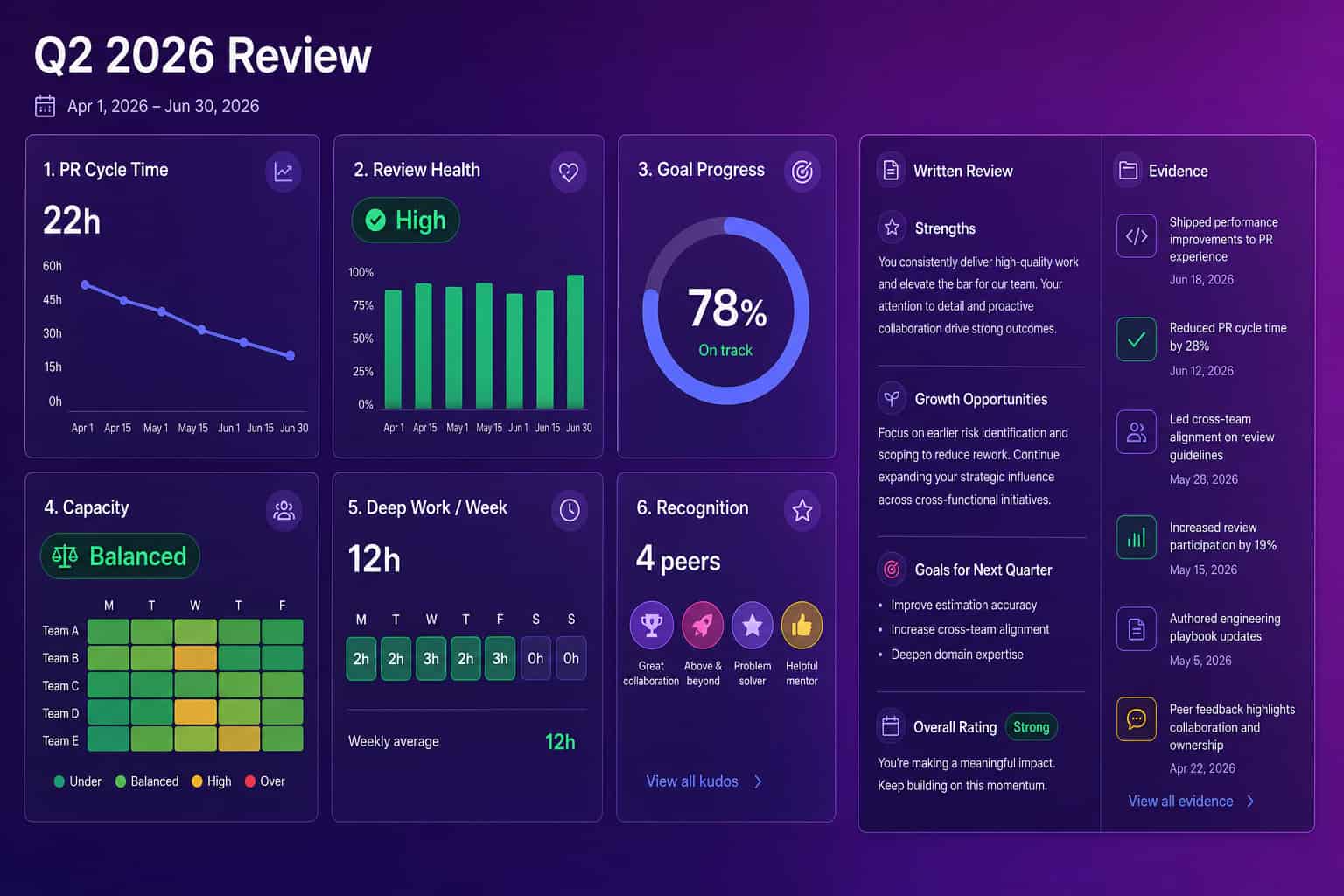
Abloomify connects to 100+ tools (GitHub, Jira, Google Workspace, Microsoft 365, Salesforce, HRIS systems) and reads PII-free work signals: no screenshots, no keyloggers, no message content, ever. For engineering teams it computes all four DORA metrics, PR cycle time, and review health straight from GitHub. When you review an engineer, the delivery record for the whole period sits in the same product as the review form, so the review starts from evidence instead of recollection.
The AI layer, Bloomy, answers questions about your team on demand, and since mid-2026 it also works on a schedule. You can have it deliver a Monday brief on velocity and stalled work, or a per-team digest before review season, by email. Dashboards you check. Bloomy checks in on you.
Pricing is $9 per seat per month billed annually, with a free tier up to 5 users, and the platform is SOC 2 Type II certified. The honest concession: if what you need is a deep HR suite with compensation planning attached, Lattice is the stronger pick. Abloomify wins when you want reviews grounded in what the team actually shipped.
2. Lattice
Lattice is the default performance suite for People-team-led organizations, and it earns the position. Reviews, 1:1s, goals, engagement surveys, and compensation live in one place, and the workflows are polished from years of iteration at scale. The limitation is structural rather than a missing feature: almost everything Lattice knows about performance is what someone typed into Lattice. If your People team runs a disciplined process and managers keep good 1:1 notes, that is plenty. If your managers are engineers who live in GitHub, the record stays thin no matter how good the forms are.
3. Culture Amp
Culture Amp came up on the engagement side and remains the strongest choice when engagement measurement matters as much as reviews. The benchmark data is the real asset: you can compare survey results against companies of your size and industry, which smaller vendors cannot offer credibly. Performance features are competent rather than distinctive. Best fit at 500+ employees where the People team wants research-grade engagement data and reviews from one vendor.
4. 15Five
15Five is built around a weekly rhythm: short check-ins, 1:1 agendas, recognition, quarterly reviews. It is really a manager-enablement tool with performance management attached, and for companies whose actual problem is "our managers never talk to their reports," that is the right thing to buy. Expect less from analytics and integrations. The tool tells you what people said in their check-ins, not what happened in the work.
5. Leapsome
Leapsome bundles reviews, goals, engagement, and a learning module into one structured platform, and it is a mid-market favorite in Europe for a reason: the review workflows flex enough to mirror a real process without hiring a consultant. If you want performance and L&D handled by one vendor, it is the practical choice. Like Lattice, it runs on entered data rather than observed work.
6. Betterworks
Betterworks is the enterprise OKR play. Its strength is goal alignment across thousands of employees: cascading objectives, check-ins against them, and reviews attached to goal progress. Large organizations that take OKRs seriously, and actually maintain them, get real value. Smaller companies tend to find it heavier than the problem they have.
7. PerformYard
PerformYard does one thing: review cycles, in whatever format your company already uses. 360s, project-based reviews, quarterly cycles, custom forms. There is no engagement module or learning platform, and it is not trying to become a suite, which makes it fast to run and easy to buy. If the requirement is clean, flexible reviews without a platform migration, it belongs on the shortlist.
How to choose: ask where the evidence comes from
One question separates these tools faster than any feature matrix. When a manager opens a review, where does the evidence on screen come from?
For most of the list, the answer is whatever people previously typed into the tool: self-assessments, peer feedback, 1:1 notes, goal check-ins. That is a forms engine with good workflow, and it can absolutely be the right buy, especially when the People team owns the process and manager discipline is high. For Abloomify, the answer is the work record itself, alongside those same forms.
Forms-based performance suite (Lattice, Culture Amp, 15Five, Leapsome)
Evidence-based performance management (Abloomify)
For the evaluation itself, run one team through one full cycle before you commit the company. Connect the data sources in week one, let the baseline build, and then compare what the tool showed you against what the manager would have written from memory. If the two match perfectly, your managers have unusually good memories. In every rollout we have seen, they do not, and the gap is where the tool earns its seat price. Engineering leaders evaluating this category should also read our performance management tools guide for engineering managers.
Where to start
If your review process runs on memory today, the cheapest fix is to start recording signals now so your next cycle has a record to draw on. Abloomify's performance management module comes with the workforce intelligence layer included at $9 per seat, and the free tier covers a 5-person pilot. Book a demo and we will show you what a review looks like when the evidence is already on the screen.

Walter Write
Staff Writer
Tech industry analyst and content strategist specializing in AI, productivity management, and workplace innovation. Passionate about helping organizations leverage technology for better team performance.